🤖 The Science Behind AI Interior Design (Explained Simply)
How AI interior works has revolutionized the way we approach home design. With artificial intelligence, homeowners, realtors, and designers can now visualize stunning spaces in minutes without manual planning or costly mistakes. Whether you’re a homeowner redesigning your living room or a realtor staging properties to sell faster, understanding the science behind AI interior can empower you to make smarter, more efficient design decisions.
We'll cover:
- How Computer Vision maps your room’s existing architecture and layout.
- How Generative Neural Networks generate photorealistic furniture and decor.
- The technical process that results in instant, stunning design transformations.
By the end of this article, you'll not only understand the technology behind AI interior design but also how to harness it effectively for your next project.
What is AI Interior Design and Why It’s the Future?
AI interior design is the sophisticated application of machine learning algorithms—specifically deep learning—to digitally transform interior spaces. Instead of relying on predefined templates, the AI processes an image, understands the space's unique characteristics, and then generates a brand-new, realistic design based on millions of data points it has learned from.
Why AI Interior Design Matters: The Core Benefits
| Feature | Description | Impact on User |
|---|---|---|
| Speed & Efficiency | Generates multiple, high-quality design options in seconds. | Cuts down weeks of traditional design consultation and planning. |
| Cost Efficiency | Allows for virtual experimentation with expensive materials and layouts. | Avoids costly physical design mistakes, saving money and time on remodels. |
| Visualization Accuracy | Creates photorealistic renderings that account for perspective, shadows, and light. | Eliminates guesswork; you see exactly what you get before buying. |
| Accessibility | Makes high-end, expert-level design available to anyone with a smartphone camera. | Democratizes design, moving it beyond professional silos. |
How AI Interior Works: The Technical Breakdown
AI interior design relies on a two-pillar technical foundation: Computer Vision and Generative Adversarial Networks (GANs), often built using sophisticated neural networks.
Pillar 1: Computer Vision and Room Mapping
This is the foundational step where the AI "sees" and "understands" the room.
A. Image Segmentation and Object Detection
When you upload a photo, the AI does not see a simple picture; it sees a collection of labeled pixels. This process is called semantic segmentation.
- Object Classification: The AI classifies every pixel in the image, labeling it as a "wall," "floor," "window," "couch," "door," or "ceiling."
- Boundary Identification: It detects the 3D boundaries, identifying the corners where the walls meet the floor and ceiling. This creates a precise spatial map of the existing architecture.
- Depth Perception: Using monocular depth estimation techniques (derived from training data), the AI calculates the distance of objects and surfaces from the camera. This is crucial for maintaining accurate perspective and scale in the final render.
Crucially, the AI separates the existing physical structure (walls, windows, doorways) from the removable contents (furniture, rugs, decor). This separation allows the AI to "erase" the existing contents and map the new design onto the preserved architecture.
💡 Deep Dive: Learn more about this crucial process in our article: How Computer Vision Maps Furniture & Layouts.
B. Understanding Architectural Constraints
The AI’s computer vision system is trained on vast datasets of architectural plans. It doesn't just see a wall; it understands the structural role of the wall. This prevents it from placing a grand piano halfway through a window or rendering a piece of furniture that would be physically impossible to fit through a doorway. It maintains:
- Scale and Proportion: Ensuring new furniture is sized correctly relative to the room’s dimensions.
- Physics: Ensuring objects are placed on surfaces (not floating) and respect gravity and balance.
Pillar 2: Design Generation Using Neural Networks
Once the room is accurately mapped, the generative phase begins. This is powered by advanced neural networks, which are responsible for the creative and artistic output.
A. Generative Adversarial Networks (GANs)
The core engine of modern AI design is often a GAN, which consists of two opposing neural networks:
- The Generator: This network takes the mapped room and the user's style input (e.g., "Minimalist Scandinavian") and attempts to generate a realistic new image, including new furniture, colors, and textures.
- The Discriminator: This network acts as a critic. It is trained on millions of real-world interior design photos and has the task of determining if the image generated by the Generator is real or fake.
The two networks compete: The Generator constantly refines its output to trick the Discriminator, and the Discriminator gets better at spotting flaws. This adversarial loop is what forces the Generator to produce incredibly photorealistic and coherent designs—designs that look indistinguishable from a photo taken by a professional interior designer.
💡 Deep Dive: Understand the technology that powers the creativity in our blog: The Role of Neural Networks in Virtual Redesign.
B. Style Transfer and Parameter Injection
When you select a style, such as "Bohemian" or "Mid-Century Modern," the AI injects specific parameters into the Generator network:
- Color Palette: The network restricts its choices to colors commonly associated with that style.
- Materiality: It prioritizes textures (wood tones, metal finishes, textile weaves) relevant to the chosen style.
- Furniture Archetypes: It selects and renders objects that fit the specific style (e.g., clean lines for Minimalist, organic shapes for Bohemian).
Pillar 3: Realistic Rendering and Blending
The final step is synthesizing the newly generated elements back into the original photo to create the final, stunning image.
A. Light and Shadow Adjustment
This is where realism is won or lost. The AI must map the original lighting conditions onto the new objects.
- If the original room photo had a strong shadow falling from the left, the newly generated couch and floor must also show a shadow falling from the left, with the same intensity.
- The AI calculates how light reflects off the new virtual materials (e.g., velvet absorbs light, chrome reflects it) to ensure visual coherence.
B. Seamless Blending and Texture Coherence
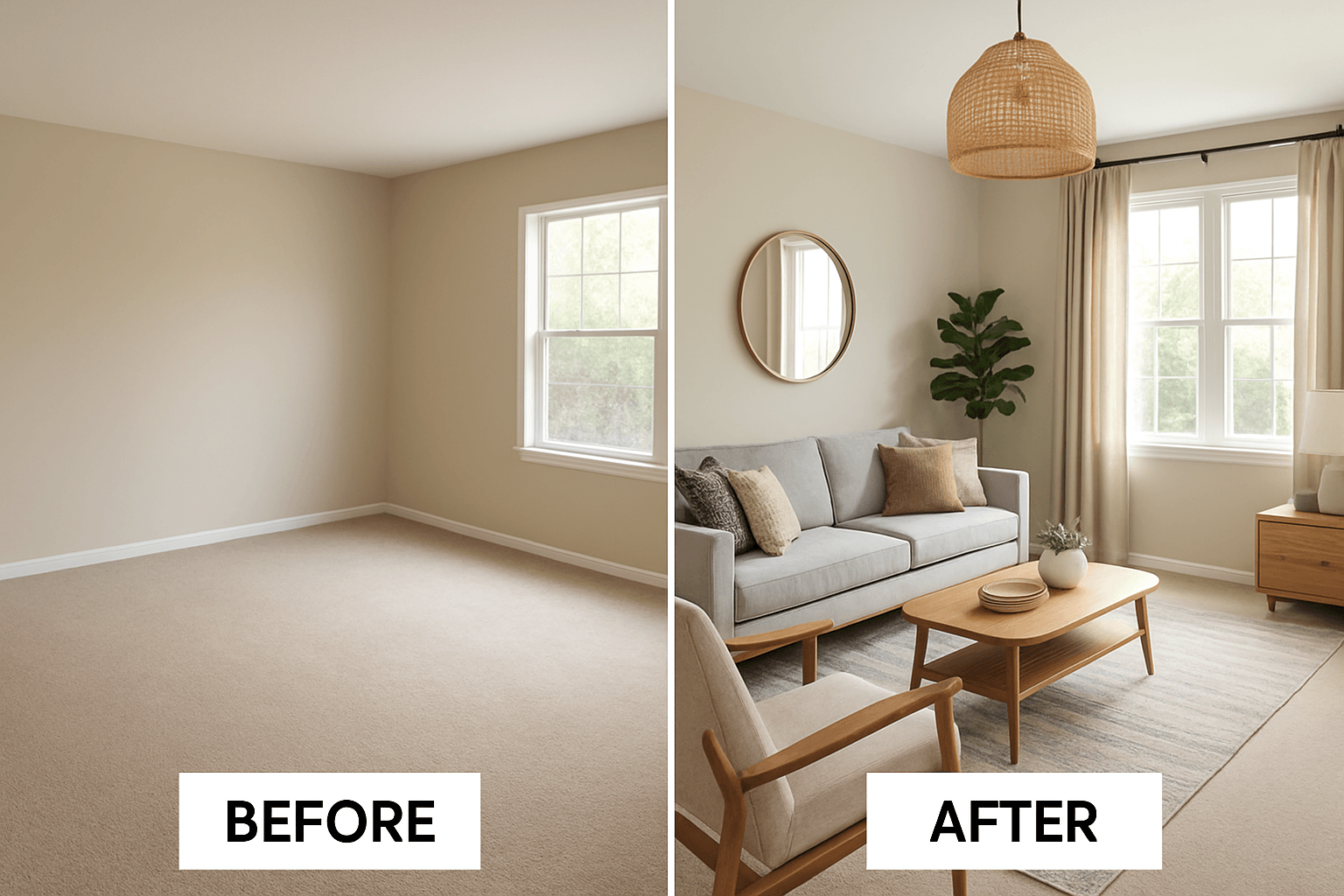
The new virtual elements are layered onto the original background. The AI ensures that the edges are perfectly blended, making the transformation appear seamless. It also matches the noise or grain of the original photograph, preventing the new furniture from looking like a flat sticker placed on the image. The result is a realistic before-and-after transformation that is ready to be shared or used for planning.
Best Practices for Harnessing AI Interior Design
To get the most professional and accurate results from AI design tools like aiinterior.pro, follow these best practices:
- Focus on High-Quality Photography: Upload high-resolution photos taken in good, natural daylight. The better the input image quality, the richer the data the Computer Vision system can extract, leading to superior results.
- One Room at a Time: Stick to clear shots of a single room. Photos capturing multiple disjointed spaces can confuse the object detection and depth perception systems.
- Use AI as a Strategic Guide: Treat AI-generated designs as a powerful source of inspiration and planning, not a mandatory blueprint. Use them to confirm furniture size, color pairings, and general mood before committing to purchases or physical changes.
- Experiment with Constraints: While AI offers boundless creativity, respect your actual architectural limitations. Test different styles but remember the physical constraints of the room's access points and structural elements.
Common Mistakes to Avoid
Avoid these common pitfalls to maximize your AI design success:
- Low-Resolution Photos: Uploading grainy or dark photos forces the AI to guess where boundaries and objects are, leading to distorted proportions or poorly rendered furniture.
- Ignoring Lighting Adjustments: While the AI handles shadows, the best designs start with a well-lit base. Do not use flash; aim for soft, even natural light.
- Overloading the Prompt: Asking for too many conflicting styles (e.g., "Minimalist Baroque Industrial Farmhouse") can result in an incoherent, confusing output.
- Skipping Internal Links: When writing about AI design, always cross-reference related blogs. This is crucial for SEO and helping users explore related topics like How Computer Vision Maps Furniture and Role of Neural Networks.
Conclusion
AI interior design is no longer science fiction—it’s a sophisticated, practical tool that empowers anyone to create professional-quality spaces quickly and efficiently. By understanding the core mechanics—how Computer Vision maps your space and how Neural Networks generate and render new designs—you can transform your home, stage properties, or explore new design ideas effortlessly, saving time and avoiding costly mistakes.
💡 Ready to see the science in action? Start with AI interior design, then read how computer vision maps furniture and layouts.


