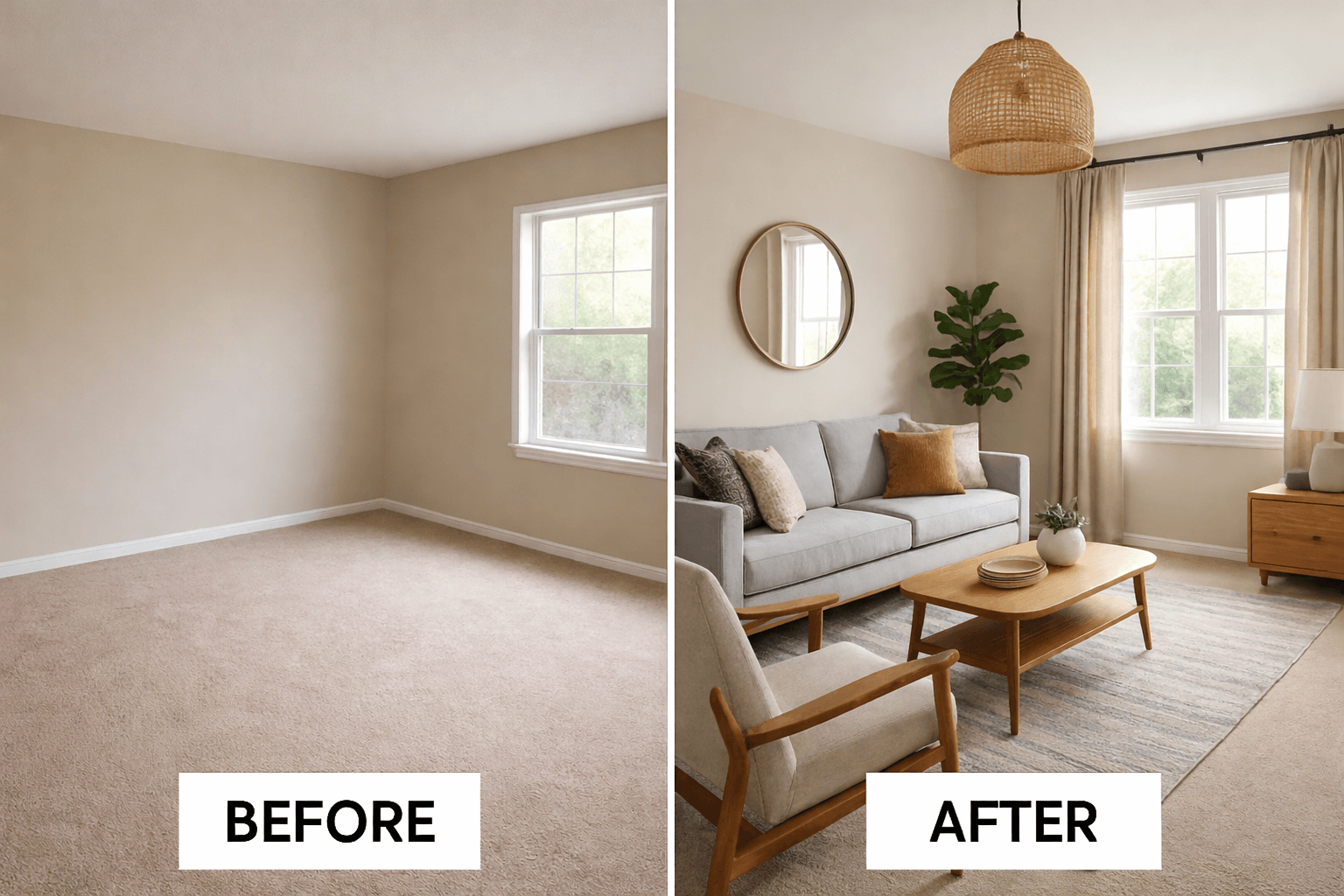
AI Real Estate Marketing: How AI Helps Properties Sell Faster
AI real estate marketing is fundamentally changing how properties are marketed, positioned, and sold in today’s digital-first housing market. What once required weeks of coordination, high upfront costs, and manual effort can now be executed in hours—often at a fraction of the price.
Real estate marketing used to be slow, manual, and painfully expensive.
Professional photoshoots. Physical staging. Endless back-and-forth with designers. Long turnaround times. And worst of all—zero personalization at scale.
Every listing followed the same broken workflow: shoot → stage → publish → hope.
AI doesn't just speed up that system. It gives agents a more flexible way to market each property.
Today, agents, brokers, and developers who understand ai real estate marketing are gaining a structural advantage—better visuals, faster launches, higher engagement, and lower costs. This shift isn’t experimental. It’s permanent.
This article breaks down how ai real estate marketing actually works, why traditional methods failed, and why professionals who ignore AI are already falling behind.
How Real Estate Marketing Worked Before AI (And Why It Failed)
Traditional real estate marketing was built around physical processes that never scaled well.
The Three Pillars of Old-School Marketing
- Physical staging – expensive, slow, location-bound
- Static photography – fixed visuals with no flexibility
- Generic listings – one presentation for every buyer type
On the surface, this looked professional. In reality, it was fragile and inefficient.
The Hidden Costs of Traditional Real Estate Marketing
Physical staging alone often costs $1,500–$5,000 per property. Photography adds more. Revisions mean reshoots, delays, and additional fees.
Once a property is staged and photographed, you’re locked in.
- If the style doesn’t resonate → too bad
- If buyer demographics shift → too bad
- If market conditions change → too bad
This system suffered from fatal flaws:
- High upfront cost per listing
- No personalization for different buyers
- Long delays between listing and launch
- Poor performance for vacant or unfinished properties
- Zero data-driven feedback
In a digital marketplace where buyers scroll fast and decide faster, this model simply collapsed under its own weight.
What AI Real Estate Marketing Actually Means
AI real estate marketing is not about automation for the sake of convenience.
It’s about using machine learning, computer vision, and generative AI to create, optimize, and personalize property marketing assets at scale.
Instead of static visuals, AI enables dynamic, adaptive marketing.
Core Capabilities of AI Real Estate Marketing
AI-powered platforms make it possible to:
- Instantly virtually stage empty properties
- Redesign outdated interiors without renovations
- Customize visuals for different buyer personas
- Launch listings faster with fewer dependencies
- Continuously improve performance using engagement data
The most important shift isn’t technical—it’s strategic.
Agents move from guessing to testing, from intuition to iteration. That mindset change alone separates top performers from the rest.
AI Virtual Staging: The Backbone of Modern Listings
If one technology defines ai real estate marketing, it’s AI virtual staging.
Why Traditional Virtual Staging Failed
Older virtual staging tools relied on manual editing and overlays. The results were obvious—and damaging.
Common problems included:
- Incorrect furniture scale
- Flat lighting and unrealistic shadows
- Poor depth perception
- Ignored architectural constraints
Buyers noticed immediately. Trust dropped. Listings underperformed.
Bad staging doesn’t just look fake—it erodes credibility.
How AI Virtual Staging Actually Works
Modern AI virtual staging systems:
- Understand room geometry and depth
- Detect walls, windows, doors, and light sources
- Place furniture at realistic scale and orientation
- Preserve the original architecture of the space
- Match shadows, reflections, and perspective naturally
This realism matters because buyers subconsciously evaluate authenticity. When visuals feel right, engagement increases. When they don’t, listings get ignored.
Platforms built for virtual staging, including AIInterior.pro, allow agents to stage vacant or outdated spaces in minutes while maintaining architectural accuracy—no physical changes required.
Personalization at Scale: One Property, Multiple Buyers
This is where ai real estate marketing completely outperforms traditional methods.
One property no longer needs one presentation.
How AI Enables Buyer-Specific Visuals
With AI, the same space can be marketed as:
- Minimalist for young professionals
- Luxury-focused for high-end buyers
- Functional and warm for families
- Neutral and efficient for rentals
Each version speaks to a different buyer psychology.
Why This Matters for Conversion
Matching visuals to buyer intent directly improves:
- Click-through rates on listings
- Time spent viewing property photos
- Inquiry quality
- Showing-to-offer conversion rates
Before AI, this level of personalization was impossible. Now it’s becoming the standard.
Speed as a Competitive Advantage in Real Estate
Speed is one of the most underrated weapons in real estate marketing.
Where Traditional Workflows Lose Time
Old processes depend on:
- Photographer availability
- Staging logistics
- Physical coordination
- Manual revisions
Each dependency adds friction and delay.
How AI Real Estate Marketing Removes Bottlenecks
AI eliminates those constraints entirely:
- No photographers required
- No staging crews
- No physical logistics
- No reshoot delays
This enables:
- Same-day listing visuals
- Instant revisions based on feedback
- Faster MLS uploads
- Quicker portal syndication
In competitive markets, the agent who launches first with high-quality visuals captures attention and momentum. AI acts as a speed multiplier.
From Guesswork to Intelligence: AI + Data
AI doesn’t just generate visuals. It learns from performance.
What AI Marketing Systems Analyze
Modern ai real estate marketing platforms track:
- Which styles perform best by region
- Which layouts generate more engagement
- Which visuals attract higher-value buyers
- Which room transformations convert better
Over time, this creates a feedback loop where marketing assets improve automatically.
No human team can consistently analyze this volume of data across listings. AI can—and does.
The Impact of AI Real Estate Marketing Across the Industry
AI adoption benefits every role in the property ecosystem.
For Realtors
- Higher-quality listings
- Faster turnaround times
- Better differentiation in crowded markets
- Lower marketing costs
For Developers
- Market properties before construction is complete
- Test design preferences early
- Localize visuals across different regions
For Brokerages
- Consistent branding across all listings
- Scalable marketing systems
- Reduced reliance on external vendors
AI doesn’t replace professionals. It amplifies those who adapt.
Common Myths About AI in Real Estate Marketing
Let’s clear the noise.
“AI makes listings misleading”
False. Poor execution does. High-quality AI preserves structure, scale, and realism.
“Buyers don’t trust AI visuals”
Buyers don’t trust bad visuals—regardless of how they’re made.
“AI is only for luxury properties”
Wrong. Mid-range and rental listings often benefit even more from AI staging.
“This is just another tech trend”
So were online listings. So was digital photography. The market already decided.
Why Ignoring AI Is a Losing Strategy
Buyers now expect:
- Clean, modern visuals
- Clear spatial understanding
- Consistent listing quality
- Digital-first presentation
Agents who rely on outdated workflows appear unprofessional by comparison.
And in real estate, perception is reality.
AI real estate marketing isn’t replacing agents. It’s separating serious professionals from amateurs.
How AIInterior.pro Fits Into the New Standard
If you want to see the practical side of this shift, start with virtual staging, browse examples in the gallery, or compare options on pricing.
AIInterior.pro is built specifically for the realities of modern real estate marketing.
It helps professionals:
- Instantly stage vacant rooms
- Redesign outdated interiors
- Generate market-ready visuals
- Maintain architectural accuracy
- Reduce staging and marketing costs
No photoshoots. No delays. No unnecessary complexity.
Just faster, smarter property marketing aligned with how buyers behave today.
Final Thoughts: This Shift Is Permanent
Every major change in real estate follows the same pattern:
- Early adopters gain leverage
- Late adopters scramble
- Traditionalists disappear
AI real estate marketing has already crossed the adoption threshold.
The question isn’t if you’ll use it. It’s whether you’ll adopt early—or be forced to catch up later.
The professionals using AI today are building advantages that compound tomorrow.


